Weather and windHow-to
How to check race-day weather with ChatGPT or Claude
The short answer
In ChatGPT or Claude, search for livedot and add it (or add https://livedot.me/mcp), and ask "What will the weather be like for the NYC Marathon?" Within 10 days of the start you get the live forecast along the course, timed to when people reach each stretch. Further out, you get 10 years of weather on that date, clearly labelled as history, not a forecast.
"What will the weather be like?" is the first race-week question, and a town's forecast rarely answers it. A marathon runner meets the heat at km 35, not at the start; a stage-race rider meets the wind on day 5, not on day 1. With livedot connected to ChatGPT or Claude, you can ask about the race itself and get the weather along the course, at the times people get there. This guide covers setting it up, the two kinds of answer, and how to read them.
What can I ask?
Name the race, the way you'd say it. For example:
- "What will the weather be like for the NYC Marathon?"
- "Weather for the Gravel Burn?"
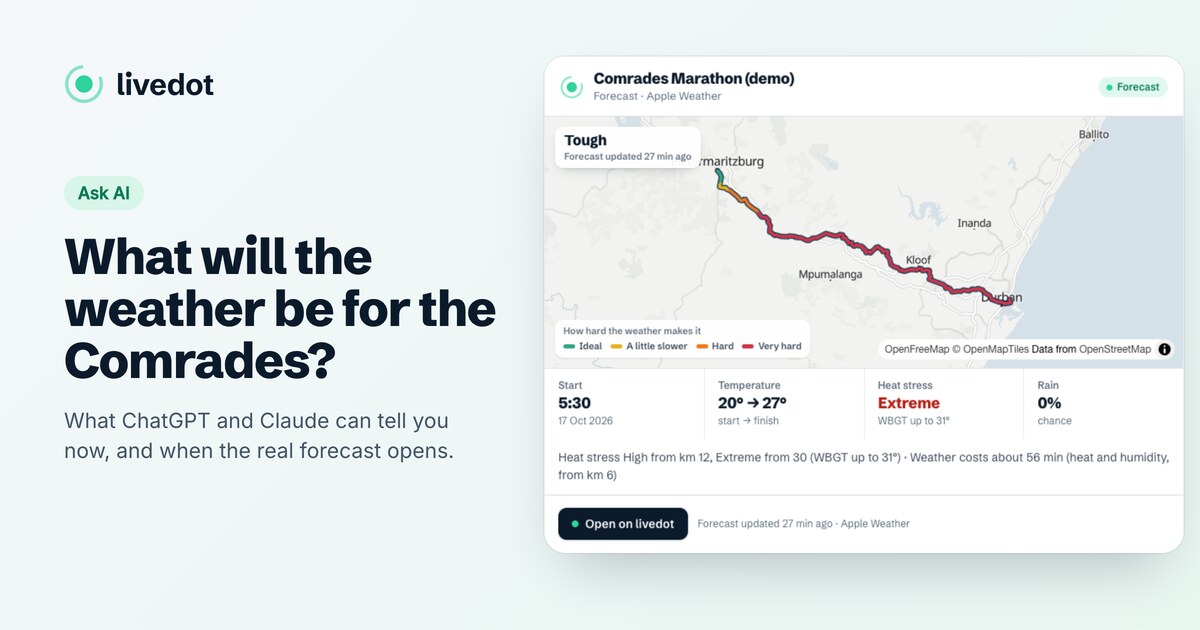
- "Will it be hot for the Comrades demo?"
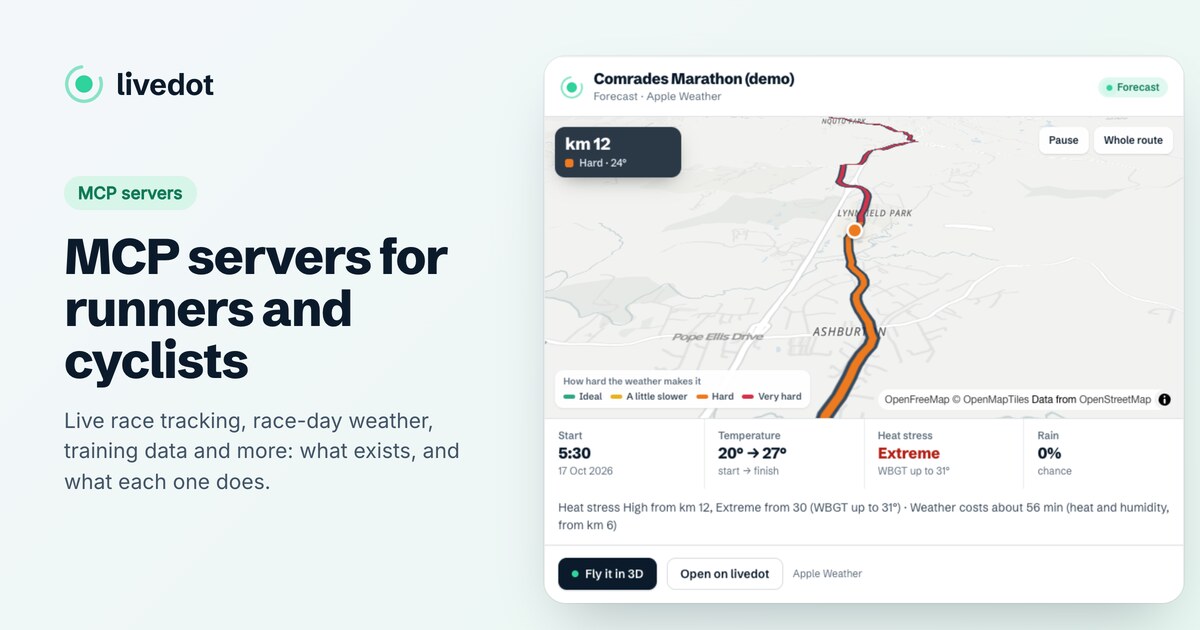
- "Fly the NYC Marathon course." (a flyover, coloured by the weather, in the chat)
If several events match, the assistant asks which one you mean. Add the year for a race with more than one edition on livedot.
How do I set it up?
Add livedot once: in ChatGPT or Claude, search for livedot, or add it at https://livedot.me/mcp. The weather is free and needs no sign-in.
Add livedot to ChatGPT or Claude
In ChatGPT or Claude, search for livedot and add it. If it isn't listed for you, add it by its address, https://livedot.me/mcp: in Claude, Customize > Connectors > + Add > Add custom connector; in ChatGPT, Plugins > + > Add custom MCP server. Following and the weather need no sign-in.
Name the race
Ask "What will the weather be like for the NYC Marathon?" or "Weather for the Gravel Burn?" Add the year if there's more than one edition.
Check which answer you got
The answer says whether it's the live forecast (within 10 days of the start) or 10 years of weather on that date (further out). Read history as what usually happens, not what will.
Read the course, not just the town
Look at the rating, the start and finish temperatures, where the wind or the heat bites, and the rain, each timed to when people reach that stretch.
Ask again closer to the day
From 10 days out, the same question returns the live forecast instead, and it updates as the forecast does.
If livedot isn't listed for you, the menus in full:
- Claude (claude.ai and Claude Desktop, every plan; the Free plan includes one custom connector): Customize > Connectors > + Add > Add custom connector, then the name and the URL. For signing in, choose Sign in when needed. Anthropic's guide: Get started with custom connectors using remote MCP.
- ChatGPT (on plans that allow custom MCP servers; OpenAI's help lists Business, Enterprise and Edu workspaces, and Pro accounts in developer mode): Plugins > + > Add custom MCP server, then the name and the URL, OAuth for authentication (the weather never asks you to sign in), I understand and want to continue, Create as a plugin. Then install it, open a new chat and type @ to pick livedot. OpenAI's guide: Connecting custom MCP servers in ChatGPT.
Developers know it as the livedot MCP: more at livedot.me/mcp. Got a route of your own? Attach its GPX and ask for the weather on it at your start time, no account needed.
Forecast or history: which will I get?
It depends on how far away the start is, and the answer always tells you which one you're reading.
| How far away | What you get | Where it comes from | How it's labelled |
|---|---|---|---|
| Within 10 days | The live forecast along the course | Apple Weather | "Forecast from Apple Weather, timed to the course" |
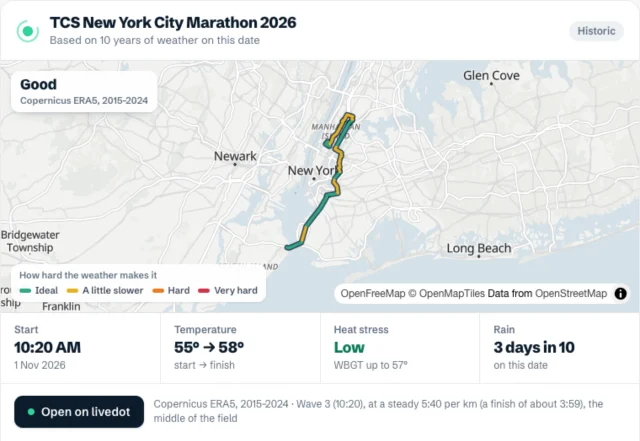
| More than 10 days | What this date has usually brought | 10 years of Copernicus ERA5 records, 2015 to 2024 | "Based on 10 years of weather on this date … not a forecast" |
| A stage race on both sides | The forecast for the near days, history for the rest | Both | "The forecast for the days inside 10 days; 10 years of weather on this date for the rest" |
Ten days is as far as a forecast reaches with any skill, so the answer doesn't pretend otherwise. Beyond it, history is the honest answer: not what will happen this year, but what usually happens on this course on this date.
What does a forecast answer look like?
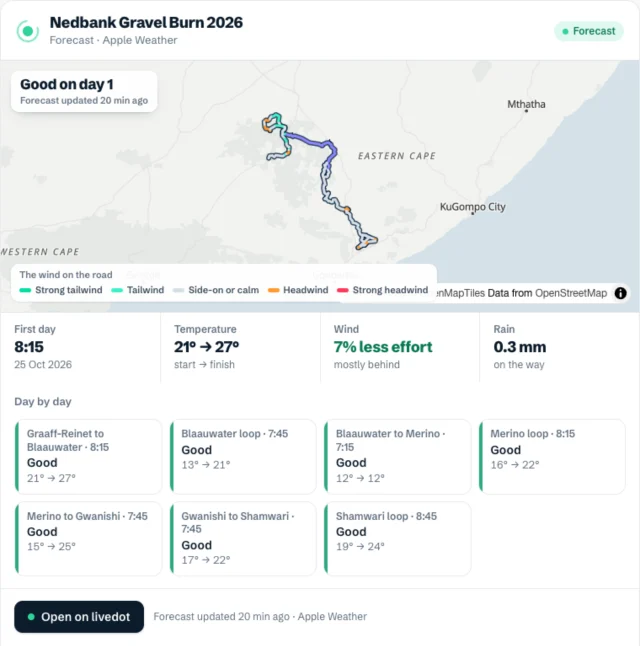
Inside 10 days, the answer reads the forecast at the hour people reach each stretch. For a multi-day race it goes day by day. This is part of a real answer for the Nedbank Gravel Burn, a week-long gravel stage race, asked on 17 October, eight days before the start:
Nedbank Gravel Burn 2026: Sunday 25 October 2026 to Saturday 31 October 2026, 7 days. The forecast for the days inside 10 days; 10 years of weather on this date for the rest. Graaff-Reinet to Blaauwater (Sunday 25 October): rated Good. About 21° at the start and 27° at the finish. A headwind (about 7 km/h) from km 35 to 41. About 0.3 mm of rain from km 78.
The first days are forecast; the last days, still more than 10 days away, are history, and say so ("Rain on about 3 days in 10; 25° was the usual high").
What's in each answer?
The same numbers as the race's own Windline or RunFast page, because they come from the same forecast engine.
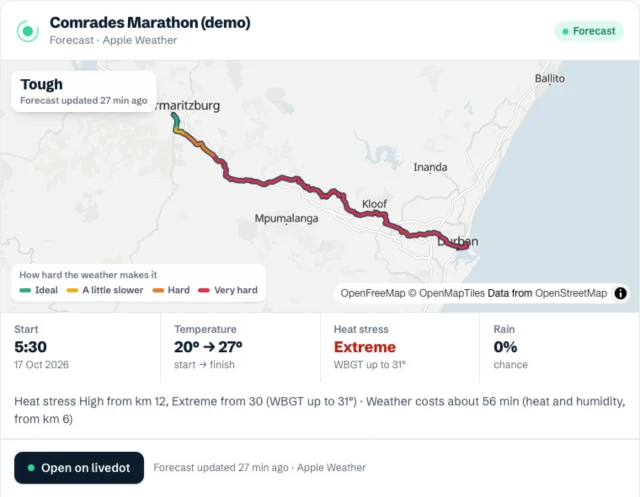
- A rating: Good, Fair or Tough, with the reason when there's a forecast, such as "Heat stress High from km 12".
- Temperatures at the start and at the finish, when people are actually there.
- For riders, the wind on the road: where it's a headwind or a tailwind, and how strong.
- For runners, the heat: heat stress from Low to Extreme, by WBGT, and with a forecast, how much the weather is likely to cost in minutes.
- Rain: the amount and where it starts, or for history, how many days in 10 had rain.
- The timing it used: for example "Timed for Wave 3 (10:20), at a steady 5:40 per km" or "for a mid-pack rider at about 20 km/h".
- A map of the course, coloured by the wind for a ride or by how hard the weather makes it for a run.
Units follow you. ChatGPT tells livedot where you are, so you get miles and °F in the US, km and °C in most places. In Claude, the race's own units lead and the others follow in brackets. Ask for either and it switches.
Which races does it know?
By name, livedot reads only what's public:
- livedot's race weather previews, such as the NYC Marathon and the Gravel Burn, each timed to the race's own start and field;
- races on a club's or organiser's page on Windline or RunFast that start in the next 14 days;
- published Windline cycling tours: ask for a tour's route, by its name or its organiser's, and every day comes with its weather;
- the demo races, the Comrades (running) and the Coast Classic (cycling), any day.
If a race isn't on livedot yet, it says so rather than guessing, and suggests one it does have. For a race it doesn't know, or for your own route and pace, use the apps: Map your run on RunFast for running, or Windline for cycling.
How should I use it in race week?
Use history to plan and the forecast to decide.
- Weeks out: ask, and read the historic answer as the odds. "Rain on about 3 days in 10" means pack for it; it doesn't mean it will rain.
- Ten days out: ask again. The forecast takes over by itself, timed to the course.
- The last few days: ask again each day. The answer says when the forecast was updated, and forecasts sharpen as the day gets closer.
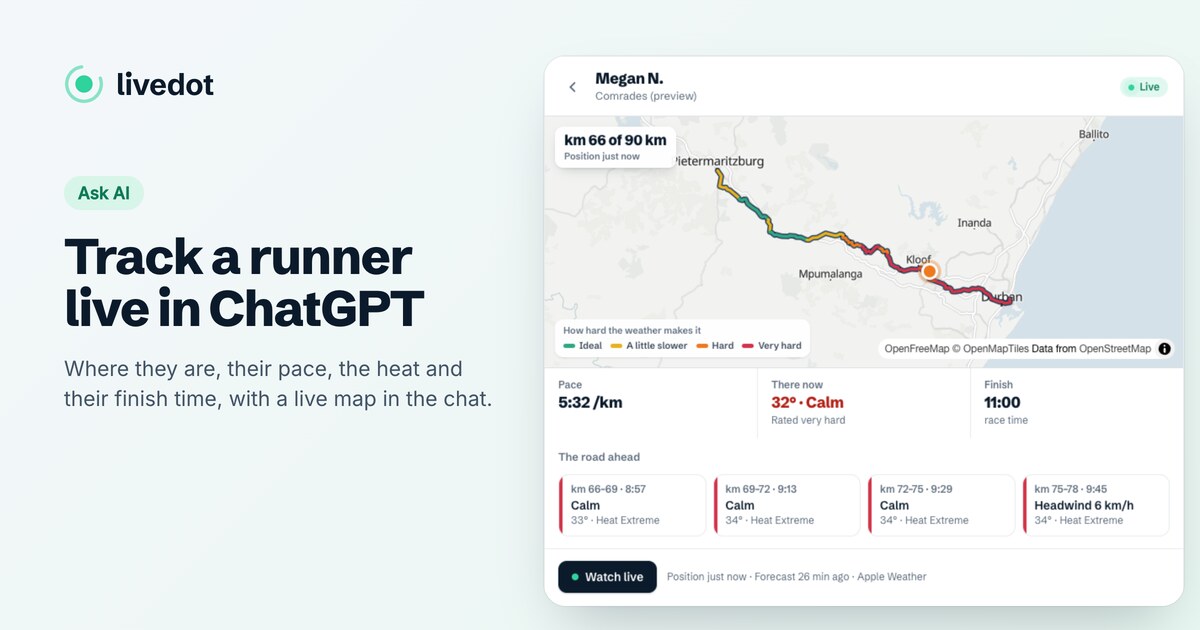
- On the day: switch to following people live. See how to track a runner live in ChatGPT.
For a big race further out, livedot's weather previews go deeper: stage by stage, hour by hour, from the same 10 years of records. See the event previews. For why a famous race's answer can surprise you, see what will the weather be for the Comrades?.
Questions
Can ChatGPT tell me the weather for my marathon?
Yes, for races with a livedot page or weather preview and races on RunFast or Windline in the next 14 days, once livedot is added. Within 10 days you get the forecast along the course; further out, 10 years of weather on that date.
How far ahead is the forecast?
Ten days. Inside that, the answer is Apple Weather's forecast, timed to the course. Beyond it, no forecast is reliable, so the answer gives what that date has usually brought over 10 years of Copernicus ERA5 records, and says so.
Is historic weather a forecast?
No. It's what the course has had on this date in 2015 to 2024: the usual temperatures, how often it rained and the usual rating. Every historic answer says it's not a forecast.
Why is the weather timed to the course?
Because a runner at km 35 or a rider on day 3 meets different weather from the start line. Each stretch is read at the hour people get there, at the pace the answer names.
Can it check my own training route?
Not in the chat. For your own route and pace, use Map your run on runfast.tech for running, or add the route to Windline for cycling.