Tour Down Under 2027 weather: what race week usually feels like
The short answer
Race week at the Tour Down Under (19 to 24 January 2027) is usually warm, dry and fairly calm: about 26–28° on the Adelaide Hills and Barossa stages and 24° on the Fleurieu Peninsula, with a light breeze from the south in the afternoons. In 10 years of records the main risk was heat, and Stage 4 to Victor Harbor was the stage most often into the wind.
The Santos Tour Down Under, the first race of each UCI WorldTour season, runs its 2027 men's race from Tuesday 19 to Sunday 24 January: six stages and about 874 km around Adelaide, the Adelaide Hills, the Barossa and the Fleurieu Peninsula. The women's race rides the last three of the same stages. Here's what that week has usually felt like, stage by stage.
What will the weather be like at the Tour Down Under 2027?
Usually warm, dry and fairly calm. A typical stage day reached about 26–28° in the Adelaide Hills and the Barossa, and about 24° on the Fleurieu Peninsula. Rain fell on 1 to 2 days in 10 at each stage. Windline's engine rated five of the six stages Good on 6 to 7 days in 10.
The heat is the thing to watch. On the inland stages, the route reached 30° or more on about 3 to 4 days in 10, and 35° or more on 1 to 2. The wind is usually light and turns through the day: from the south-east at about 13 km/h in the morning, and from the south or south-west at about 15 km/h by mid-afternoon, gusting to about 35 to 40 km/h.
| Stage | Route | Afternoon wind | Day’s high | Rain days | Rated, days in 10 |
|---|---|---|---|---|---|
| 1 · Tue 19 Jan | Henley Beach to Gumeracha164.9 km | 16 km/h from the south-westHeadwind 26%, tailwind 33% of the way | 28°17° at dawn | 2 in 10 | |
| 2 · Wed 20 Jan | Angaston loop145.6 km | 15 km/h from the south-westHeadwind 28%, tailwind 31% of the way | 28°15° at dawn | 1 in 10 | |
| 3 · Thu 21 Jan | Lobethal to Campbelltown166.2 km | 14 km/h from the south-westHeadwind 29%, tailwind 27% of the way | 26°14° at dawn | 1 in 10 | |
| 4 · Fri 22 Jan | Glenelg to Victor Harbor144.7 km | 16 km/h from the southHeadwind 39%, tailwind 19% of the way | 24°17° at dawn | 2 in 10 | |
| 5 · Sat 23 Jan | Christies Beach to Willunga Hill116.4 km | 15 km/h from the south-westHeadwind 31%, tailwind 26% of the way | 24°16° at dawn | 2 in 10 | |
| 6 · Sun 24 Jan | Norwood to Stirling136.2 km | 14 km/h from the south-westHeadwind 31%, tailwind 26% of the way | 26°14° at dawn | 2 in 10 |
Where does the wind usually help, and where does it hurt?
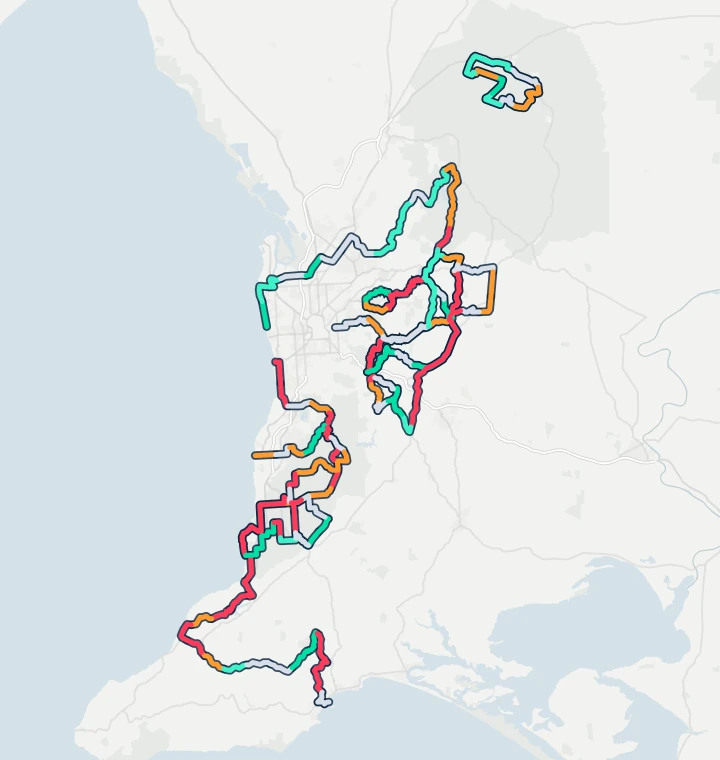
Mostly it's too light to matter. On five of the six stages, the wind cost about 1 to 3% extra effort on the middle day. The exception is Stage 4, which heads south from Glenelg into the afternoon southerly: about 11% extra effort on the middle day, and 15% or more on about 4 days in 10.
 AdelaideBarossaVictor HarborWillunga Hill123456Historic
- Strong tailwind
- Tailwind
- Side-on or light
- Headwind
- Strong headwind
Each stretch is coloured by how often the wind there was a headwind or a tailwind, at the hour the men’s race reaches it, on the days around its stage date in 2015–2024 (Historic). Where stages share roads, the later stage is drawn on top.
Weather: contains modified Copernicus Climate Change Service information (ERA5). Route lines: the Santos Tour Down Under’s stage GPX files (simplified). Map: OpenFreeMap, © OpenMapTiles, © OpenStreetMap contributors.
Where stages share roads in the Adelaide Hills, the later stage is drawn on top. The numbers are timed for the men's race at each stage's scheduled speed. The women's race starts 90 minutes later, at 12:10, so it rides Stages 4 to 6 later into the afternoon breeze.
What is each stage likely to feel like?
Each stage, with its usual day hour by hour.
Stage 1: Henley Beach to Gumeracha, Tuesday 19 January
From the beach north to Port Adelaide, then into the Adelaide Hills for three climbs of Checker Hill before the finish in Gumeracha. Rated Good on 6 days in 10, with the wind costing about 1%. Heat is its main risk: 30° or more on the route on about 4 days in 10, and 46° on the hottest day in the records.
- Wind
- 16 km/h from the south-west by 15:00Headwind adds 15% or more effort on under 1 day in 10
- Gusts
- 40 km/h55 km/h or more on 1 day in 10
- Heat
- 27° on the bike30° or more on 4 days in 10
- Morning
- 17° at dawn21° at the 10:40 start
- Rain
- 2 days in 10About 5 mm on a wet day
The usual hour along the stage: air °C, wind and gusts km/h, and the share of hours with rain. An arrow shows the way the wind usually blows; a dot, no usual direction.
Stage 2: the Angaston loop, Wednesday 20 January
A loop through the Barossa from Angaston, over Menglers Hill three times and uphill to the finish. Rated Good on 7 days in 10. The day usually reached about 28°, and 30° or more on about 4 days in 10, but the wind barely registered.
- Wind
- 15 km/h from the south-west by 15:00Headwind adds 15% or more effort on under 1 day in 10
- Gusts
- 36 km/h50 km/h or more on 1 day in 10
- Heat
- 27° on the bike30° or more on 4 days in 10
- Morning
- 15° at dawn22° at the 10:40 start
- Rain
- 1 day in 10About 4.7 mm on a wet day
Stage 3: Lobethal to Campbelltown, Thursday 21 January
Through the Adelaide Hills over Mount Lofty and twice up Corkscrew Road, finishing in Campbelltown about 5 km after the second climb. Rated Good on 6 days in 10. The day usually reached about 26°, but 35° or more on 1 to 2 days in 10, and 46° on the hottest day in the records.
- Wind
- 14 km/h from the south-west by 15:00Headwind adds 15% or more effort on under 1 day in 10
- Gusts
- 39 km/h53 km/h or more on 1 day in 10
- Heat
- 27° on the bike30° or more on 4 days in 10
- Morning
- 14° at dawn22° at the 10:40 start
- Rain
- 1 day in 10About 4.7 mm on a wet day
Stage 4: Glenelg to Victor Harbor, Friday 22 January
The stage most likely to hurt, and the women's first stage. It runs south from Glenelg through the hills to the Fleurieu Peninsula, into the afternoon southerly. It was rated Good on only 4 days in 10, and the wind added 15% or more effort on about 4. The hardest stretch was usually from Clarendon through McLaren Vale to Aldinga Beach, about km 28 to 60. It's one of the coolest stages, at about 24°. By 15:00, with the women's race on the same road, the southerly had usually built to about 16 km/h.
- Wind
- 16 km/h from the south by 15:00Headwind adds 15% or more effort on 4 days in 10
- Gusts
- 38 km/h52 km/h or more on 1 day in 10
- Heat
- 24° on the bike30° or more on 2 days in 10
- Morning
- 17° at dawn21° at the 10:40 start
- Rain
- 2 days in 10About 4.9 mm on a wet day
Stage 5: Christies Beach to Willunga Hill, Saturday 23 January
East to the first ascent of Coxs Hill, a loop through McLaren Vale and Aldinga, then Willunga Hill twice, the second time to finish. Rated Good on 7 days in 10, at about 24°, with the wind usually costing about 3%.
- Wind
- 15 km/h from the south-west by 15:00Headwind adds 15% or more effort on under 1 day in 10
- Gusts
- 35 km/h49 km/h or more on 1 day in 10
- Heat
- 24° on the bike30° or more on 2 days in 10
- Morning
- 16° at dawn21° at the 10:40 start
- Rain
- 2 days in 10About 4.4 mm on a wet day
Stage 6: Norwood to Stirling, Sunday 24 January
Straight into the Adelaide Hills from Norwood over Norton Summit, then a long loop through Birdwood, Lobethal and Hahndorf to a lap of Stirling and the finish. Rated Good on 7 days in 10. Crosswind gusts were the most common reason for a harder day, on about 2 days in 10, then heat: 30° or more on about 3 days in 10.
- Wind
- 14 km/h from the south-west by 15:00Headwind adds 15% or more effort on no days in 10
- Gusts
- 37 km/h54 km/h or more on 1 day in 10
- Heat
- 26° on the bike30° or more on 3 days in 10
- Morning
- 14° at dawn22° at the 10:40 start
- Rain
- 2 days in 10About 4.9 mm on a wet day
Which stage is likely to be toughest?
Stage 4 for the wind, and Stages 1 and 3 for the heat. Stage 4 had the fewest Good days, 4 in 10, lost mostly to the southerly. Stages 1 and 3 had the hottest days in the records, 46°. Stages 2, 5 and 6 are the likeliest easy days, each rated Good on 7 days in 10.
What should spectators bring to the roadside?
Sun protection first: the race passes in the warmest hours of the day. The organiser's stage pages list the sprints, the climbs and the times the race is due. From the weather records:
- A hat, sunscreen and water in the Hills and the Barossa. The route reached 30° or more on about 3 to 4 days in 10 on the inland stages, and 35° or more on 1 to 2.
- Shade on the hottest days. The hottest days in the records reached 44 to 46° on the inland stages.
- A light layer on the coast. Victor Harbor and Willunga were about 24° in the afternoon southerly.
- Little need for rain gear. Rain fell on 1 to 2 days in 10, and during the race on fewer than 1.
When does the real forecast open?
Ten days before each stage, in the Windline app: Stage 1's on 9 January, Stage 6's on 14 January. Load a stage's route with your own pace, and Windline rates the day Good, Fair or Tough from the forecast, with the wind on every stretch at the hour you'll get there. From then on, trust the forecast over this preview.
How did we work this out?
Each stage was ridden again on every day from a week before to a week after its date, in each year from 2015 to 2024: 150 days per stage. Each ride followed the organiser's stage GPX from the men's 10:40 start at a steady speed that reaches the scheduled finish time, about 42 to 44 km/h, on that day's hourly Copernicus ERA5 weather. Windline's engine, the same one the apps use, rated each ride.
The day's high and its rain are for the local day at the middle of each stage. A wet day has 1 mm of rain or more. ERA5's grid cells are about 25 km across, so valley winds, shelter, the sea breeze on the coast and the heat in the city don't fully show, and a pro race's speed changes with the racing and the climbs. Historic weather, not a forecast.
Sources: the Santos Tour Down Under's stages page and stage pages (the dates, the men's and women's start and finish times and places, the distances, the route notes and each stage's GPX file), and its home page (the festival dates, 16 to 24 January 2027); ERA5 hourly time series (Hersbach et al., 2020). Contains modified Copernicus Climate Change Service information (2026). Neither the European Commission nor ECMWF is responsible for any use that may be made of the Copernicus information or data it contains.
Questions
When is the 2027 Tour Down Under?
The men's race is six stages from Tuesday 19 to Sunday 24 January 2027, each starting at 10:40, from Henley Beach to Gumeracha on the first day to Norwood to Stirling on the last. The women's race rides the same routes as the last three men's stages, on 22 to 24 January, starting at 12:10. The festival runs from 16 to 24 January in South Australia.
How hot does the Tour Down Under get?
In 10 years of records around race week, a typical stage day reached about 26–28° in the Adelaide Hills and the Barossa, and about 24° on the Fleurieu Peninsula. The inland stages reached 30° or more on the route on about 3 to 4 days in 10, and 35° or more on 1 to 2. The hottest days in the records reached 46°.
Is the Tour Down Under windy?
Usually only a little: about 13 to 14 km/h on the middle day, from the south-east in the morning and from the south or south-west by the afternoon, gusting to about 35 to 40 km/h. Stage 4, south to Victor Harbor, was the stage most often into the wind, with 15% or more extra effort on about 4 days in 10.
Does it rain during the Tour Down Under?
Rarely. Rain of 1 mm or more fell on 1 to 2 days in 10 at each stage, and while the men's race was on the road on fewer than 1 day in 10.
When will the Tour Down Under forecast be available?
The real forecast opens 10 days before each stage in the Windline app: Stage 1's on 9 January, Stage 6's on 14 January. Until then, this preview is historic weather from 10 years of Copernicus ERA5 records, not a forecast.