Honolulu Marathon 2026 weather: what race day usually feels like
The short answer
Race day at the Honolulu Marathon (Sunday 13 December 2026) is usually warm and humid from the 5:00 start: about 24° with a dew point of 20°, in the dark. In 10 years of records a steady north-easterly trade wind blew at about 23 km/h, against runners heading east to Hawaii Kai and behind them on the way back, and the heat stress rose after sunrise.
The JAL Honolulu Marathon is on Sunday 13 December 2026, with the start at 5:00am on Ala Moana Boulevard: 42.2 km along the coast, through downtown and Waikiki, round Diamond Head, out to Hawaii Kai and back to the finish near the Kapiolani Park Bandstand. Here's what race day has usually felt like, section by section, for a runner in the middle of the field.
What will the weather be like at the 2026 Honolulu Marathon?
Warm, humid and breezy, from the gun. In the records, a runner from the 5:00 start set off at about 24° and finished at about 24°, with a dew point of 20°, so the air felt muggy even in the dark. RunFast's engine rated race day Tough on 9 days in 10, and never Good.
The heat stress (WBGT, the number race medical teams use) was already Moderate at the start on almost every day, at about 22°. The sun comes up at about 7:00, and the heat stress climbed after that, to about 23° by a four-hour finish. It reached High on about 6 days in 10 in the last 7 km.
| Section | Where | Air | Heat stress | Wind | Rated, days in 10 |
|---|---|---|---|---|---|
| 1 · 05:00mile 0–4 | Ala Moana Boulevard, downtown and Kapiolani Boulevard | 24°dew point 20° | ModerateModerate or more 10 in 10 | 23 km/hfrom the north-east | |
| 2 · 05:32mile 4–7 | Kalakaua Avenue through Waikiki to Kapiolani Park | 24°dew point 20° | ModerateModerate or more 10 in 10 | 23 km/hfrom the north-east | |
| 3 · 06:05mile 7–10 | Round Diamond Head to Kahala | 24°dew point 20° | ModerateModerate or more 10 in 10 | 23 km/hfrom the north-east | |
| 4 · 06:30mile 10–16 | Kalanianaole Highway east | 24°dew point 20° | ModerateModerate or more 10 in 10 | 23 km/hfrom the north-east | |
| 5 · 07:28mile 16–22 | Hawaii Kai and back along the coast | 24°dew point 20° | ModerateModerate or more 10 in 10 | 24 km/hfrom the north-east | |
| 6 · 08:17mile 22–26.2 | Kahala and Diamond Head to the finish | 24°dew point 20° | HighModerate or more 10 in 10 | 25 km/hfrom the north-east |
Where does the weather usually cost runners time?
On the middle day of the records, the weather cost a 5:40-per-km runner about 18 minutes over the whole race, and 26 minutes or more on 1 day in 10. The heat and humidity were the main cause on about 6 of those days in 10, and the wind on about 4.
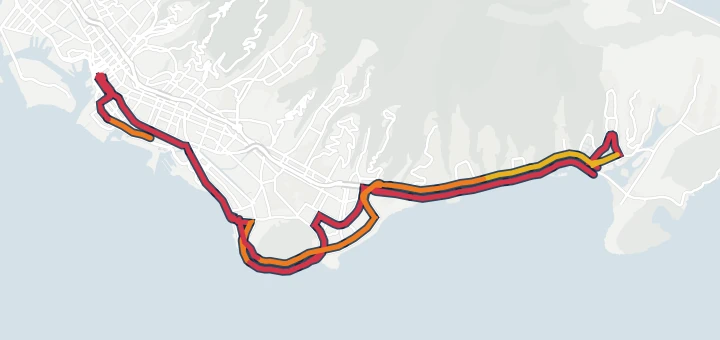 Start · Ala MoanaStartWaikikiDiamond HeadHawaii KaiFinish · Kapiolani ParkFinish123456Historic
- Ideal
- A little slower
- Hard
- Very hard
Each stretch is coloured by how hard the weather made it at 5:40 per km, at the hour a runner from the 05:00 start gets there, on the middle day of the records around 13 December, 2015 to 2024 (Historic). The numbers are the six sections below.
Weather: contains modified Copernicus Climate Change Service information (ERA5). Course line: drawn along the streets of the official 2026 course map, from © OpenStreetMap contributors. Map: OpenFreeMap, © OpenMapTiles, © OpenStreetMap contributors.
The trade wind comes from the north-east at 23 to 25 km/h, from about the same direction every morning. So it's in your face as the course heads east from Diamond Head to Hawaii Kai, and behind you on the way back. Where the course runs out and back on Kalanianaole Highway, the two directions are drawn side by side: red on the way out, orange and yellow on the way back.
What is each section likely to feel like?
Each section with its usual race morning, hour by hour, timed for the 5:00 start at a steady 5:40 per km.
1. Ala Moana Boulevard, downtown and Kapiolani Boulevard
The first 4 miles are in the dark: west on Ala Moana Boulevard, a loop through downtown past Iolani Palace, and back east on King Street and Kapiolani Boulevard. It's about 24° with a dew point of 20°, and the heat stress was Moderate on almost every day. The wind was mostly across the course. Rated Tough on 8 days in 10.
- Heat stress
- WBGT 22°Moderate or more on 10 days in 10
- Air
- 24°22–25° on 8 days in 10
- Dew point
- 20°21° or more on 1 day in 10
- Wind
- 23 km/h from the north-eastRarely a headwind
- Weather toll
- 2.3 min3.1 min or more on 1 day in 10
The usual hour here on race morning: air and dew point °C, heat stress (WBGT, coloured Low, Moderate, High or Extreme), wind km/h, and the share of hours with rain. The hours a 5:40 per km runner is here are marked.
2. Kalakaua Avenue through Waikiki to Kapiolani Park
The end of Kapiolani Boulevard, then through Waikiki on Kalakaua Avenue and round Kapiolani Park, still before sunrise. Heading south-east, the trade wind was in the runners' faces on about 3 days in 10.
- Heat stress
- WBGT 22°Moderate or more on 10 days in 10
- Air
- 24°22–25° on 8 days in 10
- Dew point
- 20°21° or more on 1 day in 10
- Wind
- 23 km/h from the north-eastMostly a headwind on 3 days in 10
- Weather toll
- 2.5 min4 min or more on 1 day in 10
3. Round Diamond Head to Kahala
Round the crater on Diamond Head Road, with the short uphill grades the organiser describes, then through Kahala. Here the course turns into the trade wind: a headwind on about 7 days in 10.
- Heat stress
- WBGT 22°Moderate or more on 10 days in 10
- Air
- 24°22–25° on 8 days in 10
- Dew point
- 20°21° or more on 1 day in 10
- Wind
- 23 km/h from the north-eastMostly a headwind on 7 days in 10
- Weather toll
- 2.7 min4.6 min or more on 1 day in 10
4. Kalanianaole Highway east
The likeliest section to hurt. Six miles east to Hawaii Kai, straight into the trade wind on about 7 days in 10, as the sun comes up. On the middle day, this section alone cost about 7 minutes, more than a third of the race's toll, and 12 minutes or more on 1 day in 10.
- Heat stress
- WBGT 22°Moderate or more on 10 days in 10
- Air
- 24°22–25° on 8 days in 10
- Dew point
- 20°21° or more on 1 day in 10
- Wind
- 23 km/h from the north-eastMostly a headwind on 7 days in 10
- Weather toll
- 6.9 min12.4 min or more on 1 day in 10
5. Hawaii Kai and back along the coast
The loop round Hawaii Kai, then back west along the highway with the wind behind you on about 7 days in 10. It's the kindest section of the race, rated Fair on 6 days in 10. But the sun is up now, and the heat stress reached High on about 3 days in 10.
- Heat stress
- WBGT 22°Moderate or more on 10 days in 10
- Air
- 24°22–25° on 8 days in 10
- Dew point
- 20°21° or more on 1 day in 10
- Wind
- 24 km/h from the north-eastMostly a headwind on 1 day in 10
- Weather toll
- 1.8 min3.2 min or more on 1 day in 10
6. Kahala and Diamond Head to the finish
Along Kahala Avenue and back round Diamond Head to the finish in Kapiolani Park, mostly with the wind behind you. By now the heat is the problem: the heat stress was at its highest, about 23°, and High on about 6 days in 10. Rated Tough on 7 days in 10.
- Heat stress
- WBGT 23°Moderate or more on 10 days in 10
- Air
- 24°22–25° on 8 days in 10
- Dew point
- 20°21° or more on 1 day in 10
- Wind
- 25 km/h from the north-eastMostly a headwind on 1 day in 10
- Weather toll
- 1.8 min3 min or more on 1 day in 10
What should runners wear and pack for race day?
Light kit for a warm, humid morning, and a plan for the wind and the sun. The organiser's course description has the course map and the turn-by-turn route. From the weather records:
- The lightest kit you race in. Expect about 24° at the start and the finish, with a dew point of 20°. It was 22° or cooler on only 1 morning in 10.
- A plan to drink early. The heat stress was already Moderate at 5:00 on almost every day, before the sun was up.
- A pacing plan for miles 10 to 16. The trade wind is usually in your face on Kalanianaole Highway, so tuck in behind other runners and take the time back with the wind on the way home.
- A cap and sunglasses after 7:00. The sun comes up ahead and to your right, over the sea, on the way out to Hawaii Kai.
Supporters at the finish can expect about 24°, with the sun well up by 9:00 and the heat stress High on most days, so shade and water matter more than a jacket.
When does the real forecast open?
Ten days before the race, in the RunFast app: on 3 December. Load the course with your own pace, and RunFast shows the heat and the wind at each stretch as you get there. From then on, trust the forecast over this preview.
How did we work this out?
The course was run again on every day from a week before to a week after 13 December, in each year from 2015 to 2024: 150 days. Each run left at 5:00 at a steady 5:40 per km (a finish of about 3:59), on that day's hourly Copernicus ERA5 weather, with its dew point and sunshine. RunFast's engine, the same one the app uses, worked out the heat stress and the weather's toll, and rated the run and each section. The start-area wait is the lowest temperature in the two hours before the start, and a wet day has 1 mm of rain or more.
ERA5's grid cells are about 25 km across, and a single one covers this whole course, partly over the sea. So every section has the same hour-by-hour weather; what changes between them is the time of day and which way runners face the wind. Air over the sea warms little between night and morning, so the streets may start a little cooler than shown and warm faster once the sun is up. Shelter from buildings and from Diamond Head doesn't show. The organiser's course is on Garmin Connect, behind a sign-in, so the line is drawn from the 2026 course map with OpenStreetMap, and timed to the official distance. Between downtown and Waikiki the organiser's written description differs from its 2026 map; the line follows the map. Historic weather, not a forecast.
Sources: the organiser's 2026 course map (the start at Ala Moana Boulevard and Piikoi Street, the route and its mile and kilometre markers), its course description (the start by Ala Moana Beach Park, the route beyond Waikiki by mile, and the finish near the Kapiolani Park Bandstand), and its race dates (5:00am, 13 December 2026); street geometry © OpenStreetMap contributors (ODbL); ERA5 hourly time series (Hersbach et al., 2020). Contains modified Copernicus Climate Change Service information (2026). Neither the European Commission nor ECMWF is responsible for any use that may be made of the Copernicus information or data it contains.
Questions
When is the 2026 Honolulu Marathon?
Sunday 13 December 2026, at 5:00am. It starts on Ala Moana Boulevard by Ala Moana Beach Park, runs through downtown and Waikiki, round Diamond Head and out to Hawaii Kai, and finishes near the Kapiolani Park Bandstand.
How hot and humid is the Honolulu Marathon?
In 10 years of records around race day, it was about 24° from the 5:00 start to a four-hour finish, with a dew point of about 20°. Heat stress (WBGT) was already Moderate at the start on almost every day, and reached High by the finish on about 6 days in 10.
Is the Honolulu Marathon windy?
Usually. A trade wind from the north-east blew at about 23 to 25 km/h on most race mornings, from much the same direction every day. It was in runners' faces from Diamond Head out to Hawaii Kai on about 7 days in 10, and behind them on the way back.
Does it rain on Honolulu Marathon day?
Not often. Rain of 1 mm or more fell on about 2 days in 10 around race day, and on fewer than 1 day in 10 while a four-hour runner was on the course.
When will the Honolulu Marathon forecast be available?
The real forecast opens 10 days before the race in the RunFast app, on 3 December. Until then, this preview is historic weather from 10 years of Copernicus ERA5 records, not a forecast.